
I Downloaded TikTok for the First Time at 41. It Took Eleven Minutes to Ruin My Evening.
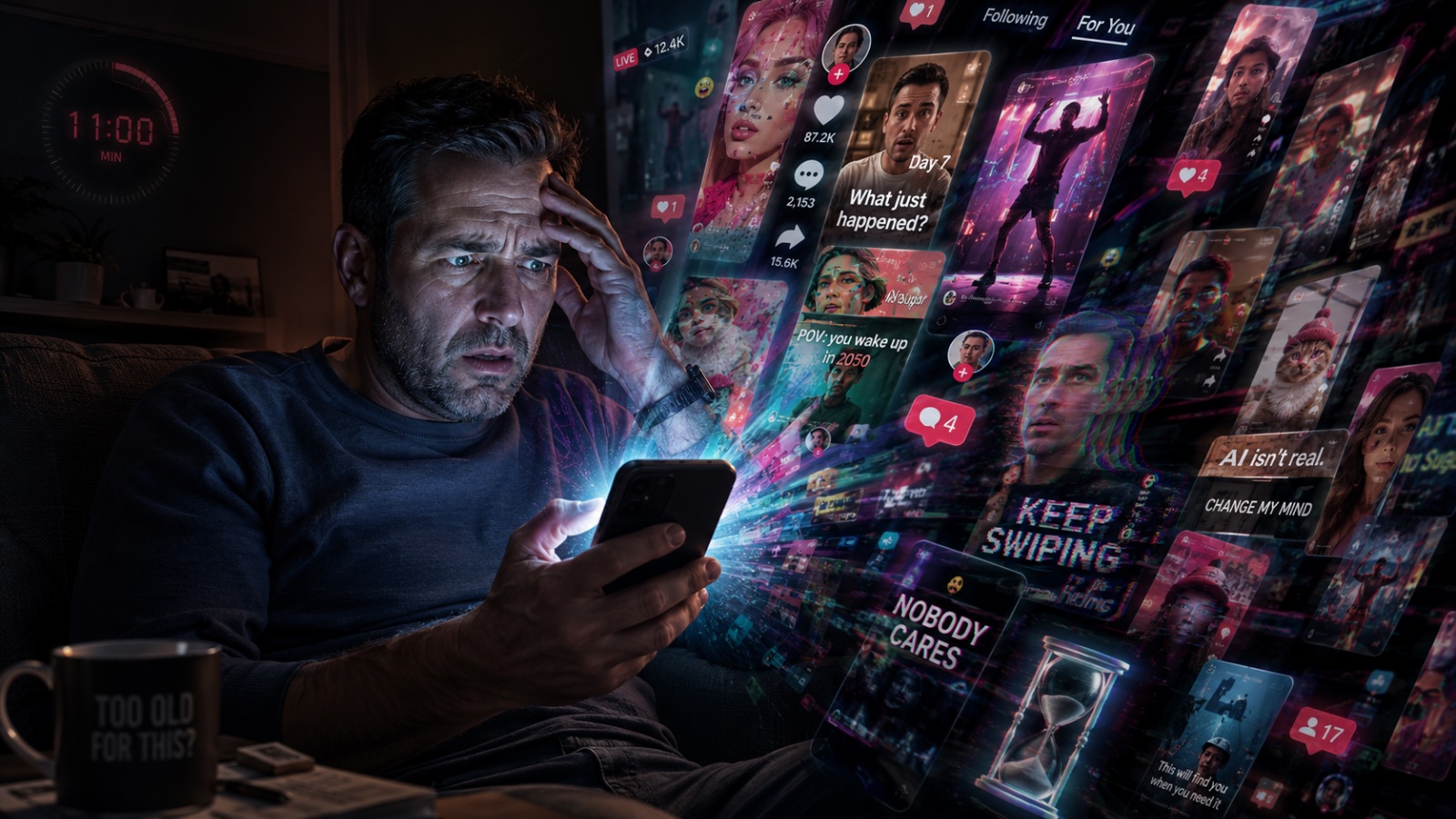
I held out for years. Not out of principle, exactly — more out of a vague sense that I wasn't missing anything. But curiosity finally won, or maybe it was just the sheer volume of cultural references flying over my head. So last night, at 41 years old, I downloaded TikTok, opened it, and had an experience I can only describe as being shaken awake every seven seconds by a stranger who has nothing to tell me. Let me start with the interface, because that's where the trouble begins. I've used a lot of software in my life. I've built software. I have a working theory that any app should be navigable by a reasonably intelligent adult within about sixty seconds. TikTok fails this test spectacularly, and I don't think it fails by accident. There's no obvious "here's what this is, here's how it works" moment. You open it and you're simply in it — mid-video, mid-noise, mid-someone-shouting-at-a-camera — with no orientation whatsoever. Swiping in different directions does different things, none of them labeled. Icons float around the edges of the screen like they're daring you to guess. It's not a user interface so much as a user ambush. And then there's the content itself. Seven seconds of nothing. Then another seven seconds of nothing. Then another. A clip of someone pointing at text. A clip of someone reacting to a clip of someone pointing at text. A dance move that lasts exactly as long as it takes to realize you've seen it. Nothing builds, nothing resolves, nothing lands. It's the video equivalent of eating a bag of packing peanuts — constant chewing, zero nutrition. What surprised me most was the physical reaction. About ten minutes in, I noticed my chest was tight. Actual, measurable anxiety — from an entertainment app. And here's the thing: I don't believe that's a side effect. I believe it's the product working as designed. The whole experience is engineered to keep you in a low-grade state of alarm, because alarmed people keep swiping. Even the logo gets in on the act. That jittery, double-exposed, glitching wordmark — it looks like a migraine aura. Somebody sat in a design review and approved a brand identity that visually communicates vibration and unease, and everyone apparently agreed this was on-message. They weren't wrong. It is. Then there's the newer wrinkle, the one nobody warned me about: I genuinely could not tell what was real. Some of what I scrolled past was clearly AI-generated — the too-smooth faces, the voices with that faint synthetic sheen. Some of it was real people. But the line between the two was blurry enough that after a while I stopped trying to distinguish, which I suspect is exactly the point. When everything is content, nothing needs to be true. For someone who spends his working life thinking about how to verify whether the voice on the other end of a call is a human being or a machine, watching an entire platform train hundreds of millions of people to shrug at that distinction was, let's say, professionally chilling. I wrote four sentences in my journal immediately after closing the app, and the last one was: all of it needs to go. Rereading it this morning, with a night's sleep and a cup of coffee, I stand by it — maybe with a slightly cooler head, but the same conclusion. Not because I'm 41 and the kids should get off my lawn. Because I've now seen the machine up close, and the machine is not confused about what it's doing. It manufactures anxiety, monetizes attention, and dissolves the boundary between real and fake — seven seconds at a time. I just deleted it. Eleven minutes, in and out. As first impressions go, TikTok made a strong one. Just not the kind you'd put on a billboard.
Comments
 Read nextA New Frontier of Shared Prosperity: Why Full U.S. Statehood is the Best Path Forward for America and GreenlandContinue reading
Join the network where everyone's real
- Publish your own posts and articles to an audience of identity-verified people — standout pieces may be featured here.
- Connect and talk with real, verified humans — no bots, no anonymous accounts.
- You choose who sees each post: your verified network, or the public feed.
Free forever