Featured Article

The Adult in the Room

There is a bill you pay every year that never shows up in your mailbox. No invoice, no receipt, and nobody asks whether you'd like to renew. It's the money Washington sends overseas — and for two generations, questioning it has been treated as proof that you're either stupid or cruel. It's neither. And the spending is only the surface. Follow it down and you find something bigger: foreign aid is the down payment on foreign alliances, and foreign alliances are how other people's quarrels become American wars. The case here is not that America should hide. It's that America should stop taking sides. Armed, rich, trading with everyone, allied to no one — the adult in the room who doesn't throw punches and doesn't have to.
Isolation is not the word
Let's kill the strawman early, because it's the only argument the other side has. Isolation means closing the door: no trade, no travel, no engagement. That's not this. Neutrality means the opposite of closing the door. It means opening it to everybody equally and refusing to guarantee anybody's war. The founders were explicit about this and we've spent eighty years pretending otherwise. Washington warned against permanent alliances. Jefferson's formula was peace, commerce, and honest friendship with all nations — entangling alliances with none. John Quincy Adams said America does not go abroad hunting monsters to destroy. None of these men were hermits. They ran a trading republic, and they knew the difference between doing business with the world and cosigning its loans. Switzerland has held this position for two centuries. It is not poor, not weak, and not irrelevant. It is where wars get ended. Now picture that posture with eleven carrier strike groups, the reserve currency, and the world's largest consumer market behind it.
What the checks actually buy
For most of the last twenty years we handed out roughly $57 to $68 billion a year, about one percent of federal spending, spiking to around $86 billion obligated in fiscal 2024. USAID was dismantled in 2025 and billions clawed back — then Congress restored about $50 billion in February 2026, nearly $20 billion more than the White House requested. The machine was knocked down and rebuilt inside a year. This argument isn't over. It's barely started.
Free money makes poor countries poorer
Giving a poor country free stuff can wreck it. This offends common sense for about ten seconds, and then it doesn't. Free food arrives, and the farmer growing that food can't compete with a price of zero. He goes under. Free clothing floods the market and the local tailor goes under with him. The trucks leave. Neither man comes back. The country is now more dependent on the next shipment than before the first one arrived. The deeper damage doesn't photograph well. A government funded from Washington doesn't need a working tax system. It doesn't need to protect property, enforce contracts, attract investors, or persuade its own citizens to fund it. Every hard reform a poor country needs to stop being poor becomes optional the moment somebody else pays. Aid doesn't just fail to build capacity. It deletes the reason to build any.
We're not buying friends, we're renting governments
Most aid isn't handed to a hungry child. It's wired to a government — and in much of the world, that government is the problem. Egypt has collected about $1.3 billion a year in American military financing since Camp David, nearly every year for four decades, straight through coups, mass imprisonments, and dismal human rights rankings. The payment never depended on behavior, so behavior never changed. That's the design flaw. We pay regimes for existing rather than for governing, and their citizens notice. Aid quietly rewires a country's accountability away from its own people and toward a donor eight thousand miles away. We congratulate ourselves on spreading democracy while subsidizing the one thing that makes democracy unnecessary — a ruler who doesn't need his people's money. And every dollar of it buys loyalty that evaporates the day the money stops. That isn't friendship. It's a subscription.
The alliance trap
Foreign Military Financing works like a gift card: billions an ally can only spend on American weapons. In fiscal 2026 the program ran about $6 billion, including $3.3 billion expedited to Israel. Israel operates under a ten-year, $38 billion agreement. Egypt takes its $1.3 billion. Jordan takes roughly half a billion. Since 2022 we've committed some $67.8 billion in defense articles to Ukraine. Defenders say the money comes home to American factories. Partly true — and notice what that concedes. This isn't charity. It's a defense-contractor subsidy routed through foreign capitals so it never has to be defended as domestic spending. The strategic cost is worse than the money. Every alliance is a tripwire that someone else controls. A mutual defense treaty means a foreign government — with its own elections, its own grudges, its own hotheads — holds a switch that can commit American sons to combat. We did not vote for their parliament. Their voters do not bury our children. That is not a partnership. It's a blank check written on American blood by people who will never be billed for it.
It also drags us into absurdities. We arm Israel and we arm Egypt, and the reason we arm Egypt is to keep it calm about the fact that we arm Israel — paying both ends of a rivalry we're also insuring. Meanwhile Benjamin Netanyahu himself has publicly called for phasing out American military aid to Israel, arguing his country has come of age. When the recipient says the arrangement has outlived its purpose, listen.
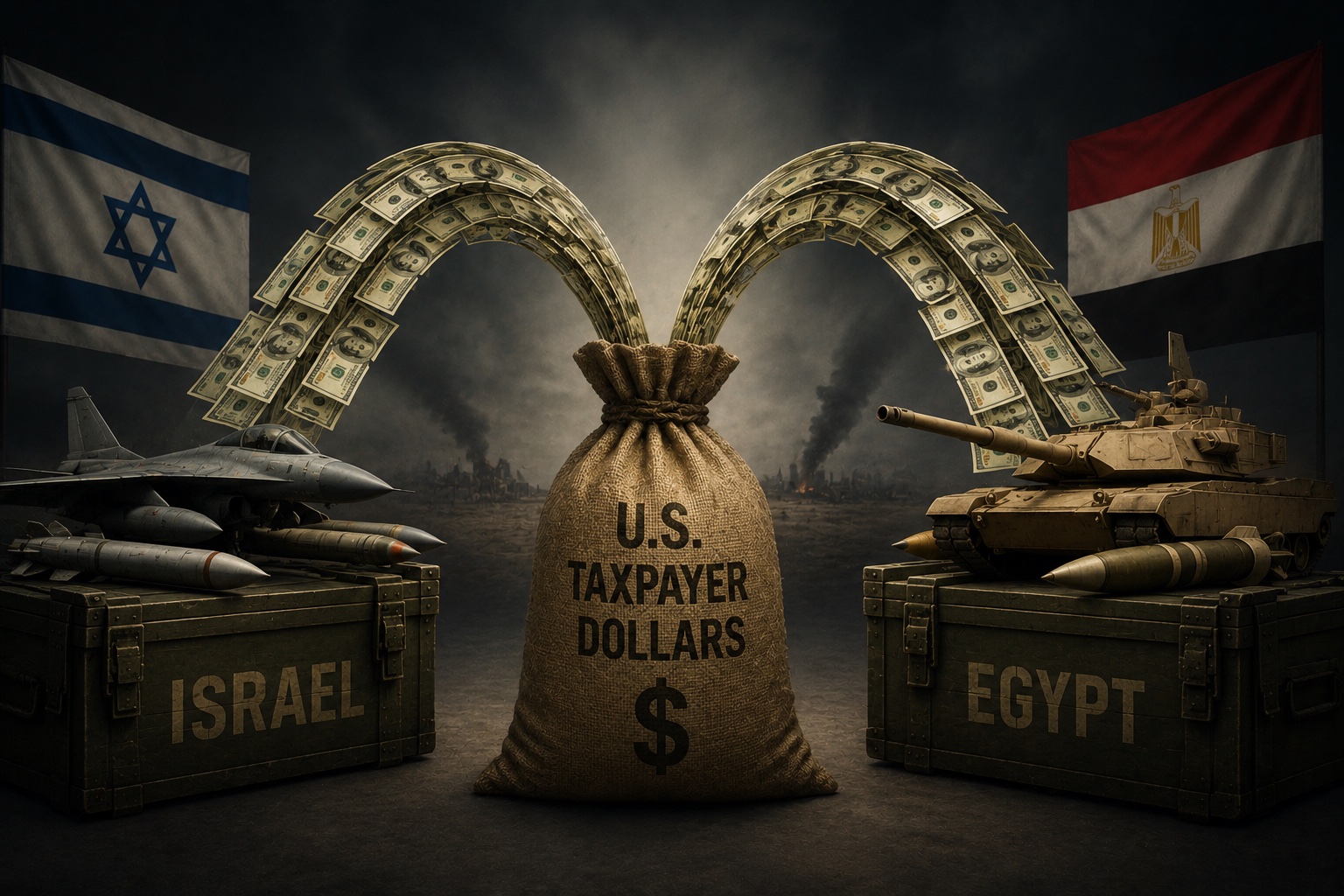
And the alternative already exists. Congress hasn't approved significant new Ukraine funding since April 2024. Instead, NATO members buy American weapons with their own money and send them onward — over $6 billion to U.S. manufacturers so far. Same factories, same jobs, someone else's checkbook, and no American troops obligated. We accidentally ran the experiment. Selling works. Giving doesn't.
What it costs at home
Every dollar sent abroad is borrowed, because we run a deficit. We finance other nations' budgets with money we don't have and pay interest on it forever. Then look around your own town. Deficient bridges. Water mains from the Eisenhower administration. Buckets under school ceilings. And overseas money gets a fraction of the audit a local road job gets, in places American inspectors often can't safely visit. We demand receipts from a contractor paving a parking lot and shrug at a wire transfer to a foreign ministry. There's a moral confusion here too. Charity is what a person freely does with what belongs to him. Money taken by law and spent abroad by an agency isn't generosity — nobody earns credit for a donation somebody else was forced to make.
The doctrine: cut it off, then be the adult
Not a review. Not a task force. Not a five percent trim. Here's the replacement. 1. End general foreign aid on a fixed date. Announce it years out so nobody can claim ambush, then hold the line. 2. Sunset the alliances, keep the peace. The NATO treaty itself permits withdrawal on one year's notice. Convert every mutual defense pact into what a neutral power actually offers: non-aggression, open trade, intelligence cooperation where interests align, and no automatic obligation to fight. Give allies a decade to build their own forces. Most can afford to. The ones that can't were never defensible on our terms anyway. 3. Stay armed to the teeth — at home. Neutrality without strength is an invitation. Fund the nuclear deterrent, the navy, homeland air and missile defense, the industrial base, the border. Close the garrisons. A fleet that protects sea lanes for everyone is worth more than a base that guarantees one nation's borders. 4. Sell to all, favor none. Weapons at full commercial price, financed like any other export, with one neutral rule applied without exception: no sales to any party in an active war. That rule is what makes neutrality credible instead of rhetorical. It costs us some contracts. It buys us the trust of every capital on earth. 5. Trade, not aid. Drop tariffs and quotas on goods from poor nations. Access to the American consumer is worth more than any appropriation and arrives as wages instead of handouts. Trade with both sides of every quarrel. Neutral money spends everywhere. 6. Become the venue. The neutral superpower is where treaties get signed, disputes get arbitrated, prisoners get exchanged, and enemies meet without either one losing face. Geneva does this with a small army and it made the Swiss indispensable. We could do it with a real one. 7. Let charity be charity. Churches, missions, hospitals, and foundations already work everywhere aid goes, on smaller budgets, funded by donors who cut them off when results don't come. Strengthen the deduction and get out of the way. Clear the fees off immigrant remittances too — families already send home more than Washington does, and it lands in kitchens, not ministries. 8. Emergencies only, hard sunset. Earthquakes, tsunamis, famine. Narrow, fast, publicly audited, and legally expiring so relief can never quietly become a foreign entitlement. 9. Bring the rest home. Debt, bridges, water, grid. A solvent America is the most useful thing this country can offer the world. Broke nations rescue nobody. Sixty years and trillions of dollars have not produced one country that graduated from aid into prosperity because of it. The ones that escaped — South Korea, Taiwan, Poland, Vietnam — did it by making things and selling them to us. We keep sending money to people who needed a customer. And we keep signing treaties that let strangers decide when our children go to war. Stop writing checks. Close the bases. Open the market. Then be the one nation everybody can still talk to.
Comments
 Read nextThe Weaponization of Public Health for the Revocation of Constitutional RightsContinue reading
Join the network where everyone's real
- Publish your own posts and articles to an audience of identity-verified people — standout pieces may be featured here.
- Connect and talk with real, verified humans — no bots, no anonymous accounts.
- You choose who sees each post: your verified network, or the public feed.
Free forever